5 Signs your SEA campaign needs a serious rethink

If your campaigns are burning budget without delivering results, these five warning signs might explain exactly why.
The good news is that underperforming Google Ads campaigns are rarely a mystery. The same root causes show up repeatedly: broken tracking, poor structure, irrelevant search terms, disconnected landing pages, and bidding strategies working against the account. Spot one of these signs and you have a problem. Spot several and you have an urgent rethink to do.
Sign 1: Your cost per acquisition keeps rising with no clear explanation
Rising CPA is one of the clearest signals that something structural has gone wrong.
The average Google Ads account wastes 20 to 30% of its budget on irrelevant or low-intent searches. That is not a targeting problem in isolation. It is a systems problem. When campaigns lack clean conversion data, tight structure and active search query hygiene, the algorithm trains on bad signals and pays for clicks that will never convert.
Before increasing your budget or adjusting bids, audit the basics first. Is your conversion tracking firing correctly? Are you measuring the right actions, with no duplicate conversions inflating the numbers? A well-structured account gives Smart Bidding clean signals and keeps performance data readable. Poor structure forces the algorithm to mix signals from campaigns with different goals, audience types and offer categories, which increases CPA and makes it nearly impossible to identify what is and is not working.
If CPA has been rising for multiple quarters without a clear cause, the issue is almost never the bid strategy. It is the quality of the data feeding it.
Sign 2: Your search terms report is full of irrelevant queries
If you are not reviewing your search terms report weekly, you are likely paying for traffic that has nothing to do with your business.
This is one of the most common and most costly mistakes in Google Ads accounts. Broad match keywords and Performance Max campaigns in particular can trigger ads for queries that are loosely related at best. Without a disciplined negative keyword strategy, budget leaks steadily into low-intent or completely irrelevant searches.
In 2026, users expect ads to clearly answer their question or solve their problem. If your ad copy feels outdated or vague, users scroll past it. Even with good impressions, low relevance leads to a low click-through rate.
The fix is systematic. Review your search term reports at least once a week. Add negatives aggressively. Group your keywords by intent rather than by theme alone. A high impression share with a low CTR is often a sign that your ads are appearing for queries they should not be targeting.
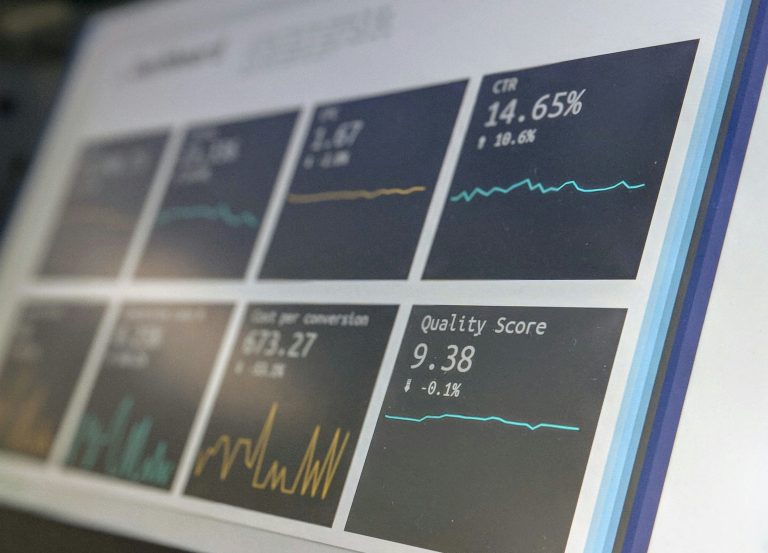
Sign 3: Your Quality Score is below 6 on your main keywords
Quality Score is Google’s rating of the relevance and quality of your keywords, ads and landing pages. It directly affects your ad position and the price you pay per click. A low Quality Score means you are paying more for worse placement than your competitors.
The three components of Quality Score are expected click-through rate, ad relevance and landing page experience. If any of these is rated “below average”, you have an actionable problem to fix.
Here is what low Quality Scores usually indicate:
- Your ad copy does not closely match the keywords triggering it
- Your landing page does not deliver on the promise made in the ad
- Your keyword groups are too broad, mixing unrelated terms in the same ad group
- Your destination page loads slowly or provides a poor mobile experience
Improving Quality Score from 5 to 8 can reduce your CPC by 30% or more while improving your ad position simultaneously. It is one of the highest-leverage optimisations available in any Google Ads account.
Sign 4: Your landing page experience is rated “below average”
This sign is directly visible in your Google Ads account, yet it is frequently ignored.
A below-average landing page experience means Google has assessed that users who click your ad are not finding what they expected. They are either leaving immediately, not engaging with the page content or encountering a slow and frustrating experience. All of that depresses Quality Score, increases CPC and wastes your budget on traffic that will never convert.
In 2026, slow-loading or cluttered landing pages reduce trust instantly. If your landing page does not clearly match the ad message, users hesitate. The message match between your ad and your landing page is not optional. If your ad promises a specific solution and your landing page opens on a generic homepage, you will lose people who were already interested.
The fix is not always a complete rebuild. Start with the headline, the load speed and the alignment between ad copy and page content. Often those three changes alone are enough to move the rating from below average to average or above average, with a measurable impact on conversion rate.
Sign 5: You are spending more but not seeing proportional revenue growth
Budget increases should drive proportional growth, at least in the early stages of scaling. If you are increasing spend and seeing diminishing returns, or no returns at all, that is a structural signal, not a volume problem.
CPA has risen for multiple quarters without a clear cause. Budget is increasing but revenue is not keeping pace. The team is reacting to performance drops rather than running planned tests. Conversion tracking has not been audited since the account was set up. All four of those patterns point to the same issue: the account is being managed reactively rather than systematically.
Before scaling spend, your account needs a clear measurement framework, a structured testing cadence and bidding strategies that are working from enough conversion data to be reliable. Smart Bidding requires at least 30 conversions per month to optimise effectively. Below that threshold, you are asking an algorithm to make decisions it does not have the data to make well.
As Frederick Vallaeys, former Google Quality Score engineer and co-founder of Optmyzr, puts it: “The accounts that scale most efficiently are the ones that fix measurement first. You cannot optimise what you cannot accurately measure.” (Source: Optmyzr Blog, 2025)
What should you do if you recognise these signs?
Start with an audit, not a budget change.
Review your conversion tracking setup first. Then look at your search terms, your Quality Scores, your landing page ratings and your campaign structure. Most underperforming accounts have significant efficiency gains available before any additional spend is justified.
According to WordStream’s Google Ads benchmarks, the average Google Ads conversion rate across industries is 3.75% for search campaigns. If your account is converting well below that, the issue is almost certainly structural rather than competitive.
And according to Google’s own guidance on Smart Bidding, automated bidding strategies perform significantly better when accounts have clean, consistent conversion data and well-defined campaign goals. Giving the algorithm better inputs is consistently more effective than manually overriding its decisions.
Fix the foundation first. Then scale.

Caroline is a Performance Marketing Consultant, specialising in paid media strategy, SEA, paid social and lead generation for B2B and B2C brands.
View All Articles