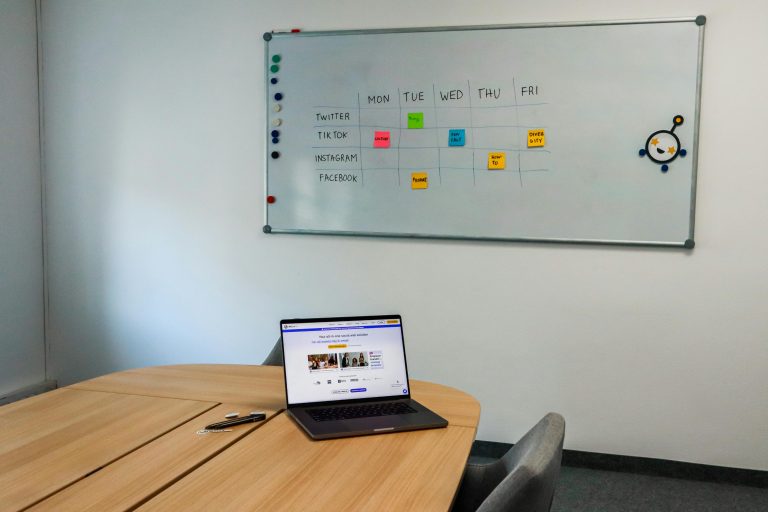
How to build a social media content calendar that actually gets used

A content calendar only works if your team sticks to it. Here’s a practical approach to planning social media content that doesn’t fall apart after week two.
The reason most content calendars fail is not a lack of planning. It is a lack of simplicity. Teams build elaborate systems that are too complex to maintain alongside the day-to-day demands of running a business. The fix is to design your calendar around what your team can realistically sustain, not around what looks impressive in a spreadsheet.
Why do most content calendars stop being used after a few weeks?
The problem is almost always the same. The calendar was built for an ideal world, not the real one.
Teams plan five posts per week across three platforms, create ambitious themes for every day of the month, and then run out of content ideas or bandwidth by week three. The calendar gets abandoned. Posts become reactive and inconsistent. And the algorithm penalises the silence.
According to Sprout Social data, 73% of brands report that maintaining consistent posting frequency is their top social media challenge. The solution is not to plan more. It is to plan smarter, with a system that is easy to follow even on a busy week.
What should a realistic content calendar actually include?
Start with the minimum viable structure. A good content calendar does not need to be a 20-column spreadsheet. It needs to answer four questions for every piece of content:
- What platform is this post for?
- What is the format (video, carousel, image, text)?
- What is the topic or content pillar?
- When will it go live?
Everything else, including copy, creative assets and links, can be added as the post is built. The goal at the planning stage is to have a clear publishing schedule that the team understands and can follow without a briefing every week.
Data shows that brands using a structured visual planning approach reduce content production time by 40% while increasing engagement rates by 22%. The structure itself is the advantage. It removes the decision fatigue that causes teams to procrastinate on content creation.
How do you decide what to post and how often?
Define your content pillars first. Content pillars are the three to five recurring themes your brand consistently talks about. They give your calendar a backbone and make content ideation significantly faster.
For a digital marketing consultancy, pillars might include: paid media strategy, SEO tips, client results, industry news and behind-the-scenes content. Every post should fit into one of those pillars. If it does not, it probably should not be on your calendar.
On posting frequency, consistency beats volume every time. Accounts that post regularly from the same time windows see 34% higher reach than sporadic posters, according to Hootsuite’s algorithm analysis. Three reliable posts per week outperform seven inconsistent ones. Pick a cadence your team can maintain without stress and protect it.
As Hootsuite’s Head of Social Content, Amanda Wood, puts it: “The brands that win on social media are not the ones posting the most. They are the ones showing up reliably, with content their audience actually wants to see.” (Source: Hootsuite Social Media Trends Report, 2026)
How far ahead should you plan your content?
Plan one month at a time, create two weeks in advance.
Monthly planning gives you enough visibility to align content with business goals, campaigns and seasonal moments. Creating two weeks ahead gives you a buffer for unexpected events while keeping content fresh and relevant.
At the start of each month, set your content themes and identify any key dates worth addressing: product launches, industry events, relevant awareness days or seasonal moments. Then map these across your platforms in the calendar.
At the start of each week, finalise the posts going live in the following two weeks. Write the copy, prepare the visuals and schedule using a tool like Buffer, Hootsuite or Later. This workflow keeps the team ahead of the curve without requiring anyone to plan three months of content in one sitting.
What formats work best by platform in 2026?
Choosing the right format for each platform is part of making your calendar work harder with the same volume of content.
On TikTok, video earns a median engagement rate of 3.39%, which is 77% higher than carousels and photo posts. On Instagram, carousels lead the platform with a 6.9% median engagement rate, higher than Reels, single images and Stories. On LinkedIn, long-form posts and document shares consistently drive the highest reach and engagement among professional audiences.
This means the same piece of content can be repurposed across platforms in different formats. A long-form LinkedIn post becomes a short video for TikTok and a carousel for Instagram. One idea, three posts. This is the most practical way to maintain a consistent calendar without burning out your team.
How do you keep the calendar useful over time?
Review it monthly, not quarterly.
At the end of each month, spend 30 minutes reviewing which content performed best. Your content calendar should track not just publication dates but also projected and actual performance metrics. In 2026, vanity metrics like follower count are secondary to retention rates, share ratios and save rates.
Look at what drove the most meaningful engagement, which topics resonated, and which formats underperformed. Then adjust the next month’s plan accordingly. This monthly feedback loop is what separates teams that improve over time from those that repeat the same content indefinitely.
According to Buffer’s State of Social Media Engagement report, the best-performing accounts share one consistent trait: they treat their content calendar as a living document, not a fixed plan. They adapt based on data and audience response rather than sticking rigidly to a plan that is no longer working.
For a deeper look at scheduling strategy and platform-specific best practices, Sprout Social’s annual index is one of the most reliable resources available.
A content calendar that gets used is one that is simple enough to follow on a difficult week. Define your pillars, set a realistic cadence, plan one month ahead, create two weeks in advance and review monthly. That system, applied consistently, will outperform any overly complex planning tool that gets abandoned by February.
Build for consistency first. Optimise for performance second.

Caroline is a Performance Marketing Consultant, specialising in paid media strategy, SEA, paid social and lead generation for B2B and B2C brands.
View All Articles